What it is
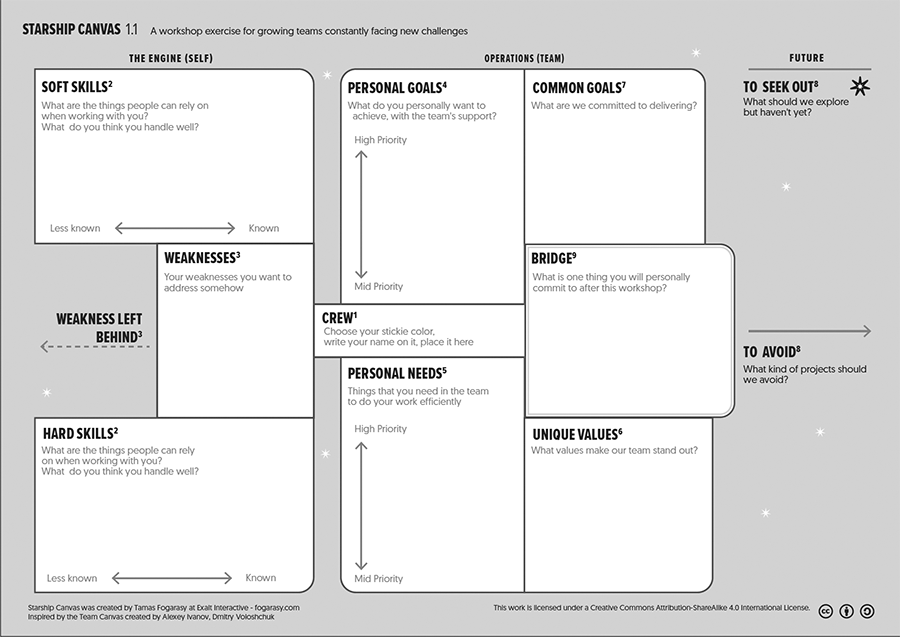
The Starship Canvas is a workshop exercise for teams that frequently face new challenges together. It's a large visual canvas divided into sections that cover individual skills, personal goals, team values, common goals, and commitments. Think of it as a team retrospective, but deeper and more personal.
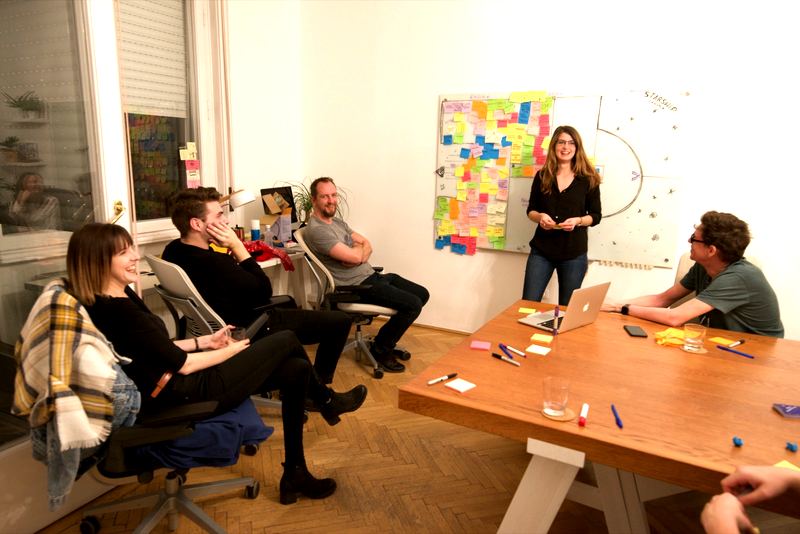
The exercise takes 2 to 4 hours depending on team size and format. Every section is filled with thoughts from the whole team: 3 minutes of silent writing, followed by discussion. It's structured enough to keep the conversation productive, but open enough to surface things that normally don't come up.
The steps (rounds)
- Start with Crew. Choose your sticky note colour, write your name on it, place it on the canvas. Add some special titles, make it fun.
- Hard Skills and Soft Skills. Let everyone write down what people can rely on when working with them – both known and less known skills. Soft skills won't change much over time but it's interesting to see if someone writes something different next time.
- Weaknesses. Individual or shared weak spots to address. Some weaknesses will be left behind by members over time – it's a great opportunity to celebrate these small wins.
- Personal Goals. What does each person want to achieve, with the team's support? Goals are very different for each person and reveal what drives their creativity, work ethic and morale.
- Personal Needs. Slowly shift the focus from individual to team by addressing what each person needs to do their work efficiently. Small things matter: who needs a certain kind of feedback, who needs more space or silence.
- Unique Values. What values make your team stand out? It summarises the individual strengths on a team level and helps articulate why people like working together. One of the more important sections – spend more time with it.
- Common Goals. What is the team committed to delivering over the next period?
- Seek Out and To Avoid. What should the team explore but hasn't yet? What kind of projects should you avoid? You can add subcategories like markets, industries, technologies or ethical considerations.
- The Bridge. The moment where each crew member commits to one thing they will personally do after this workshop. After commitments are set, conclude by quickly running through the main points again.
How to run it
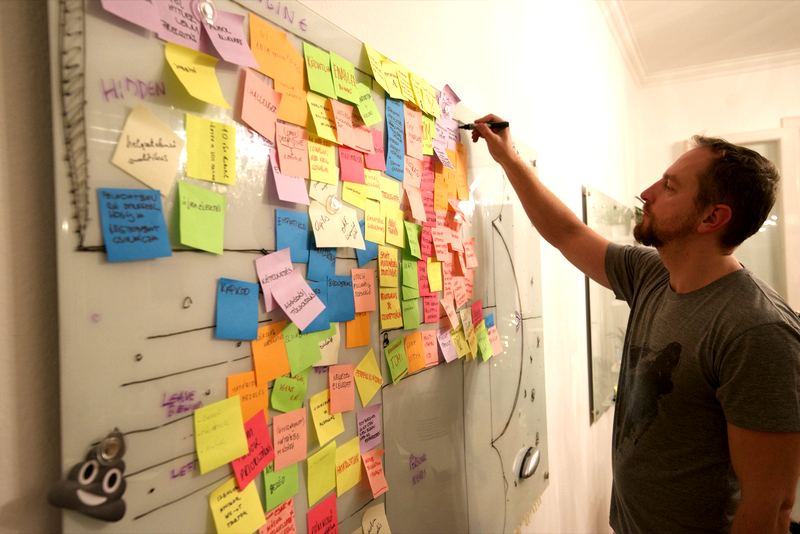
Every section of the canvas is filled the same way: team members silently write down 3–5 thoughts on separate sticky notes and place them on the canvas. You can run each round in two formats, depending on how much time and reflection you allow.
Fast format
After writing, the team does a gallery walk – a few minutes of reading everyone's notes in silence. Then discuss what stood out.
| Phase | Time |
|---|
| Facilitator reads the section prompt | 1 min |
| Silent writing (3–5 sticky notes) | 3 min |
| Place stickies on canvas + gallery walk | 3 min |
| Group discussion | 8 min |
| Total per round | ~15 min |
Deep format
After writing and the gallery walk, split into small groups of 3–4. Each person shares their notes, followed by group reactions. After all members have shared, each subgroup presents their highlights to the full team.
| Phase | Time |
|---|
| Facilitator reads the section prompt | 1 min |
| Silent writing (3–5 sticky notes) | 3 min |
| Place stickies on canvas + gallery walk | 3 min |
| Individual sharing in subgroups (3 min per person) | 9–12 min |
| Subgroup reactions | 5 min |
| Each subgroup presents highlights to full team | 5–10 min |
| Total per round | ~30–35 min |
Mixing both
Use Fast for informational rounds (Crew, Skills, Personal Needs, Common Goals, Seek Out & Avoid) and Deep for the rounds that benefit from individual sharing (Weaknesses, Personal Goals, Unique Values, Bridge). Split into subgroups of 3 whenever your team has 6 or more people.
How long it takes
All-Fast (9 Fast rounds): about 2 hours for any team size.
Mixed (5 Fast + 4 Deep rounds, plus setup and wrap-up):
- 3–5 people – ~4–4.5 hours (half day)
- 7–9 people – ~4 hours (half day, subgroups of 3)
- 12 people – ~4.5 hours (half day, subgroups of 4)
Example schedule (Mixed, 9 people, subgroups of 3):
- 9:00 – Setup + intro
- 9:15 – Crew, Skills (Fast)
- 9:40 – Weaknesses (Deep)
- 10:15 – Break
- 10:30 – Personal Goals (Deep), Personal Needs (Fast)
- 11:20 – Unique Values (Deep)
- 11:55 – Break
- 12:10 – Common Goals, Seek Out + Avoid (Fast)
- 12:35 – Bridge (Deep)
- 13:10 – Wrap-up
- 13:30 – Done
Running it remotely
Use Miro or FigJam as the canvas. Each person gets their own sticky colour. Use the built-in timer for silent writing. Gallery walk becomes 2 minutes of silent scrolling. Discussion over voice – cameras on, encouraged for Deep rounds. Use breakout rooms for subgroups in Deep format.
Facilitator guide
Materials and room checklist
- Sticky notes: one colour per person throughout the whole workshop (so everyone can identify their own)
- Markers: 1 thick marker per person (keeps notes readable from a distance)
- Printed canvas: A2 or A1 (DIN), or drawn on a whiteboard
- Wall space or table to mount the canvas flat
- Timer (phone is fine)
- Room with enough space for people to stand around the canvas
Who should facilitate
Someone who is not the team lead or manager, if possible – the leader should participate as a crew member. If the team lead must facilitate, they should share last in Deep rounds to avoid anchoring. The facilitator's job: keep time, read section prompts aloud, manage transitions – not to interpret or judge.
Psychological safety
Before starting, set three norms:
- Everything shared stays in the room unless the team agrees otherwise.
- No judgement on what people write – especially in Weaknesses and Personal Goals.
- It's OK to pass on sharing something out loud. The sticky is still on the canvas.
For teams doing this the first time: acknowledge that some sections feel vulnerable. That's the point.
Pre-workshop questions
Send these with the invite to help people arrive prepared:
- What can people rely on you for – both hard skills and softer traits?
- What would you like to get better at? What do you struggle with that affects your work or the team?
- What do you want to achieve in the coming period, with the team's support?
- What do you need from the team to do your best work?
- What values or qualities make this team different from others you've worked in?
Bridge commitments
The Bridge is the most important section on the canvas. A good commitment is:
- Specific: "I will set up weekly 1-on-1s with each designer" – not "I'll communicate more"
- Time-bound: "by end of next sprint" or "starting Monday"
- Owned: one person, one commitment – not "we should…"
Each crew member writes 1–2 commitments on stickies and reads them aloud. These are the most important stickies on the canvas – photograph them.
After the workshop
Review Bridge commitments at the next team standup or retrospective. At the next Starship Canvas session – recommended every 3 to 6 months – start by revisiting last session's Bridge. Celebrate what was done. Acknowledge what wasn't – no blame, just awareness.
Keep past canvas photos. Comparing canvases over time is one of the most valuable parts.
Why I made it
I created the Starship Canvas when Exalt Interactive was project-based – a team of 8 to 12 designers assembling around client projects, then reconfiguring for the next one. Every new combination needed to rebuild trust and alignment fast. We kept hitting the same problem: the team was growing, projects were shifting, and the things that made us work well together were changing faster than we could talk about them.
I couldn't find a tool that did exactly this, so I made one.
The company has since grown and the model changed – today we work more with outsourced staff contracts than project teams. But the canvas applies anywhere a team has enough autonomy to define its own goals and ways of working. Any group that ships together and needs to stay aligned can use it.
What I've learned using it
After running this exercise repeatedly at Exalt, a few things stood out. The Weaknesses section gets better every time – people get more honest as trust builds. The Personal Goals section consistently surfaces surprises, even among people who've worked together for years. And the Bridge, where everyone makes individual commitments, is the part that actually changes behaviour between sessions.
The starship analogy comes from Star Trek Enterprise – a diverse crew with different strengths working towards the same goal, steering the ship into unknown frontiers together.
To boldly grow where no team has grown before.